
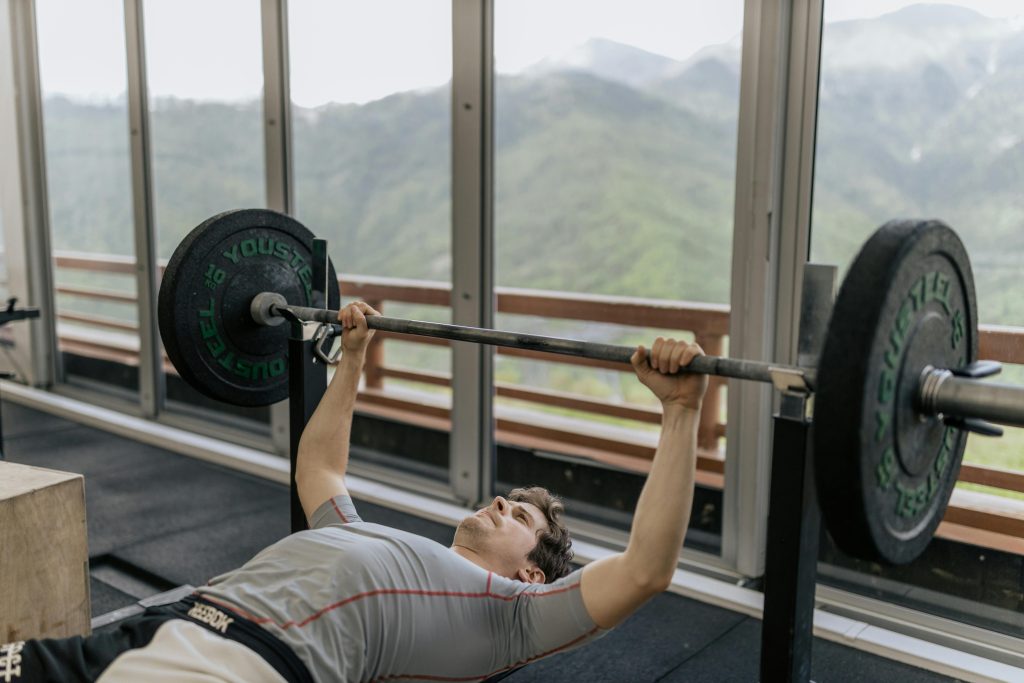
What is the Bench Press?
The bench press is one of the most popular and most effective exercises you can do for building upper body. Many fitness enthusiasts like myself would highly recommend this as a go-to lift for anyone looking to improve their upper body strength . It is a compound exercise which means it works multiple muscles making it a time efficient way to work your upper body .
While whether you would need to prioritise this or not does depend on your own personal specific fitness goals, having a strong bench press has many benefits regardless of whether your main focus is strength, muscle growth or overall health. Its definitely not an exercise you want to skip.
The Bench Press can be very intimidating for beginner, especially if you do not have a training partner so in this guide I will walk you through step by step with simple instructions to get you to perform your perfect bench press and feel confident bench pressing. This guide will also have some tips and tricks that maybe useful for more experienced lifters.
What muscles are trained in the Bench Press?
The bench press is a compound movement meaning it works multiple different muscles. The muscles targeted does vary depending on the variation of the bench press. In this guide we will be looking at the conventional bench press. Here is a breakdown of all the muscles which are involved in the bench press:
Primary Muscles
Chest (Pectoralis major)
The primary muscle which targeted by the bench press is the chest and the technical name for it is the pectoralis major. This makes up a large part of your chest muscle and doing a conventional bench press will more specifically target the middle and lower portions of your chest. To work the upper part of the chest their are other exercises you can do such as incline dumbbell press or incline bench press.
Shoulders (Deltoids)
The second primary muscle targeted is the deltoids. The deltoids assist in the movement and help aid with the pushing the weight back up and also help with controlling the weight. The front deltoid which is the front part of your shoulder is the main part of the shoulder that does the bulk of the work in assisting you move and control the weight although all parts of the shoulder all do play a role in the lift.
Triceps
The triceps is the third primary muscles that are targeted in the bench press. The main purpose of this muscle in the bench press is they act as a supporting muscle to help you extend your arm out and straighten them out and help you lockout. Strengthening your triceps can really help you boost your bench press strength.
Secondary Muscles
Lats (Latissimus Dorsi)
This is the largest muscle on your back which cover the middle of your back and stretches down to the sides of your torso. It is the most strongest part of your back and helps stabilise your body during the lifts. This allows you to keep your body tight and supported throughout the lift.
Trapezius
This is your upper back muscle and really helps with stabilisation and assists you when lifting of at the start of your lift. This muscle is important and keeping them tight and pinned to the bench and tight can really help protect your shoulder and maintain good form.
Biceps
Although the biceps don’t play a major role in the bench press they act as a stabiliser and play a supportive role when lowering the bar and controlling it.
Core
Your core muscles also helps stabilise your entire body on the bench. Having a strong core improve force transfer from your lower to upper body and reduces risk of injury, especially when using an arch in your lift.
Step-by-Step: How to perform the Bench Press
Follow these simple steps to perform you perfect bench press safely and effectively:
Step 1: The Set Up
The first step to the bench press is setting up your equipment. Adjust the bench so that when you lie underneath the bar the bar is roughly around your eye level.
To find out where you need to place your hands their is a quick test you can do to find this out:
- Grip the bar slightly wider than shoulder width and unrack the bar.
- Lower the bar down to your chest and check if your elbows are at 75-90 degree angle and if your forearms are vertical. If it is not adjust your grip to fix this.
- Try slightly narrower and wider grips to find what is comfortable for you.
If its your first time you don’t necessarily need to unrack the bar to do this test as you can just imagine lowering a bar but it would be best to use a real bar for accuracy.
Step 2: Positioning yourself on the bench
- Lie Flat on the Bench in a position where your eyes are directly under the bar. This gives you enough space to unrack the bar safely and comfortably
- Plant your feet in to the ground firmly. Your entire foot should be in contact with the floor, this allows you to generate leg drive during your lift.
- Creating an arch in your lower back – To do this pull your shoulder blades back as if you are trying to pinch them together whilst also thinking about pushing your chest to the celling or puffing your chest up. You can imagine al ball between you upper back muscles and you are trying to squeeze it as tightly as you can.
- Maintain 3 points of contact with the bench at all times- Your glutes, upper back and head stay in contact with the bench throughout.
Step 3: The lift
- Grip the bar with wrist wrapped all the way around the bar
- Take a deep breath and push the bar up so its in directly above your should shoulders and bring slighltly forward so its above upper chest.
- Tuck your elbows in so they are at a 45 degree angle.
- Lower the bar slowly towards the nipple line or just slightly below until the bar makes contact with your chest.
- Push right back up so the bar is back in to the upper chest position and exhale as you push up.
- Repeat for number of reps.
- Gently place the bar back on the hooks once you have completed your set.
If you follow all of these steps you have now completed a perfect bench press with good technique.
For a great visual guide I recommend checking out this quick video by ScottHermanFitness: